
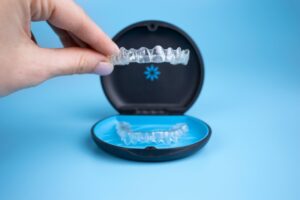
If you experience jaw pain, headaches, or clicking when you chew, you may be wondering whether Invisalign can solve the problem. Since bite alignment often plays a role in jaw discomfort, it’s a common question. The answer is that Invisalign may help relieve TMJ symptoms for some patients, but it is not a cure for every case of TMJ disorder.
Understanding the connection between your bite and your jaw joints is the first step toward finding the right treatment.
What Is TMJ Disorder?
The temporomandibular joints (TMJs) connect your lower jaw to your skull. These joints allow you to talk, chew, yawn, and move your jaw comfortably. When something affects the joints, surrounding muscles, or ligaments, it can lead to temporomandibular disorder (TMD).
Common symptoms include:
- Jaw pain or tenderness.
- Clicking or popping sounds.
- Difficulty opening or closing the mouth.
- Frequent headaches.
- Facial pain.
- Earaches or a feeling of fullness in the ears.
TMJ disorder can have many causes, including teeth grinding, arthritis, injury, stress, and bite misalignment.
How Can Invisalign Help?
Invisalign gradually moves your teeth into better alignment using a series of clear, custom-made aligners. If your TMJ symptoms are caused or worsened by a misaligned bite, correcting that bite may reduce unnecessary stress on the jaw joints.
As your teeth move into healthier positions, some patients experience improvements in jaw function and less muscle strain. Invisalign may also distribute biting forces more evenly, making chewing more comfortable.
During treatment, some patients also find that wearing their aligners helps reduce the effects of nighttime teeth grinding by creating a protective barrier between the teeth. However, Invisalign aligners are not designed to serve as long-term nightguards.
Invisalign Isn’t Right for Every TMJ Case
Because TMJ disorder has many possible causes, Invisalign isn’t always the appropriate treatment. If your symptoms stem from arthritis, an injury, or muscle-related issues rather than your bite, clear aligners alone may not provide relief.
Your dentist will perform a comprehensive examination to identify the underlying cause of your symptoms before recommending treatment. In some cases, Invisalign may be combined with other therapies, such as a custom nightguard, physical therapy, stress management techniques, or medication.
If you’re struggling with jaw pain or other TMJ symptoms, the most important step is getting an accurate diagnosis. While Invisalign can be an effective solution for patients whose bite contributes to their discomfort, every case is unique. A thorough evaluation allows your dentist to determine whether Invisalign is likely to help or if another treatment approach would better address your symptoms.
About the Author
Dr. Gary Chaffee has been practicing dentistry since 1975. He earned his dental degree from the Loma Linda University School of Dentistry and later studied in a 2-year Progressive Orthodontics Program. In 1992, he became an International Instructor for Progressive Orthodontics and also earned his certification as an Invisalign provider. With this type of niche expertise, Dr. Chaffee is the perfect professional if you’re seeking Invisalign treatment. Book your appointment online or call our Newbury Park office at (805) 480-0033.